Thursday, March 7, 2019

Course Update 3/7/19

I can't believe it's March already!  Tree sap is starting to flow and the leaf buds on maple trees are swelling and turning red.  This week saw another blast of winter but spring is not far away.  The cold temps provided ideal conditions for another productive week of tree work in several areas.

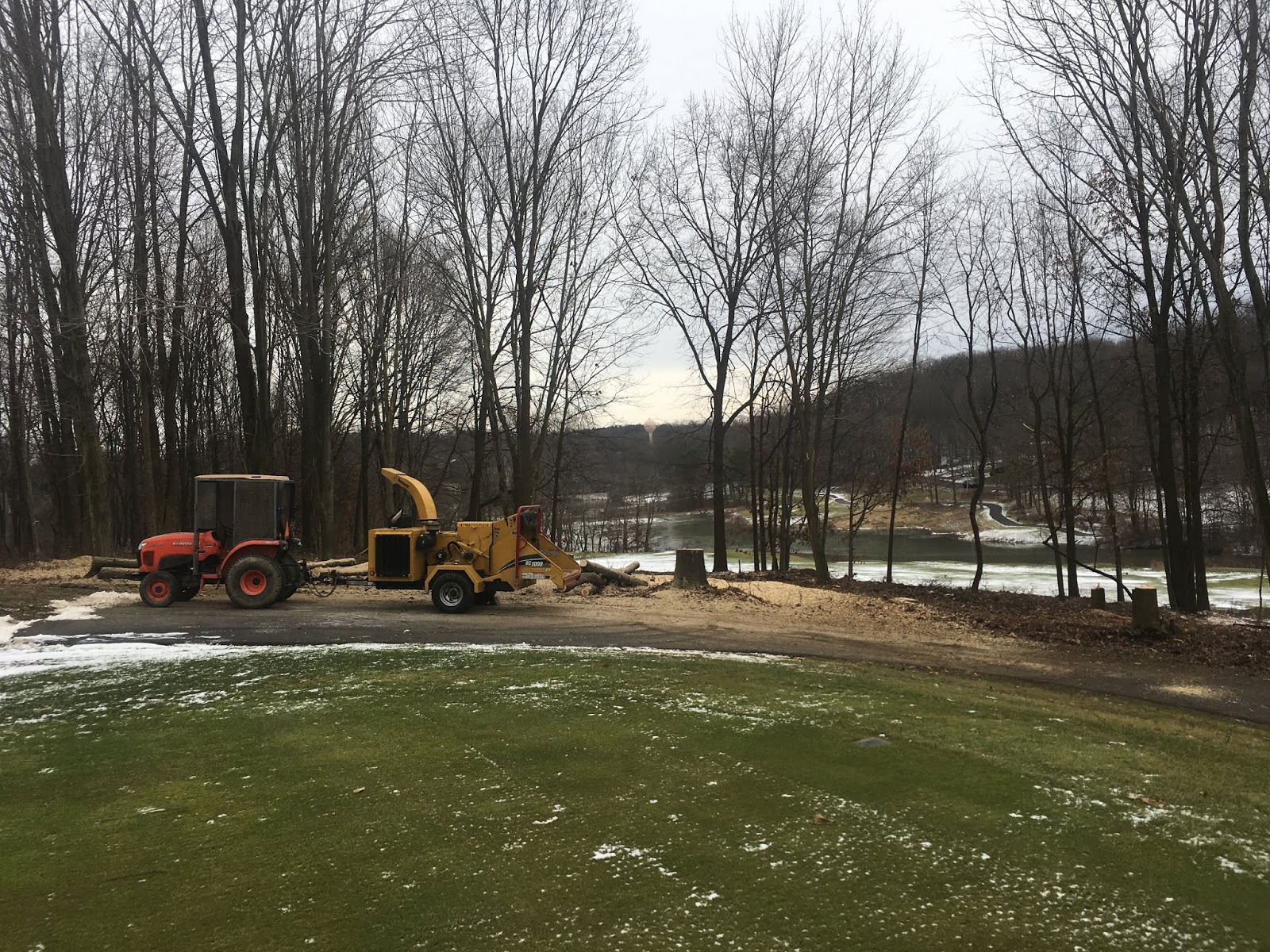
We removed the final two trunks from this Oak on the hill to the right of Lakes #7 green.  The tree has been in decline for many years and there was a significant amount of dead wood in the canopy that posed a hazard to everyone passing by.  The stump is nearly 50" in diameter and will have to be cut into several pieces in order to remove it.
Here's a view of the area surrounding the stump.  There is more bare soil than turf, but that will change now that the tree is gone.
We spent a few more days working to the right of the tees on Lakes #9.  Frozen ground makes it easier for the equipment to work on the slopes and causes less damage to the turf.
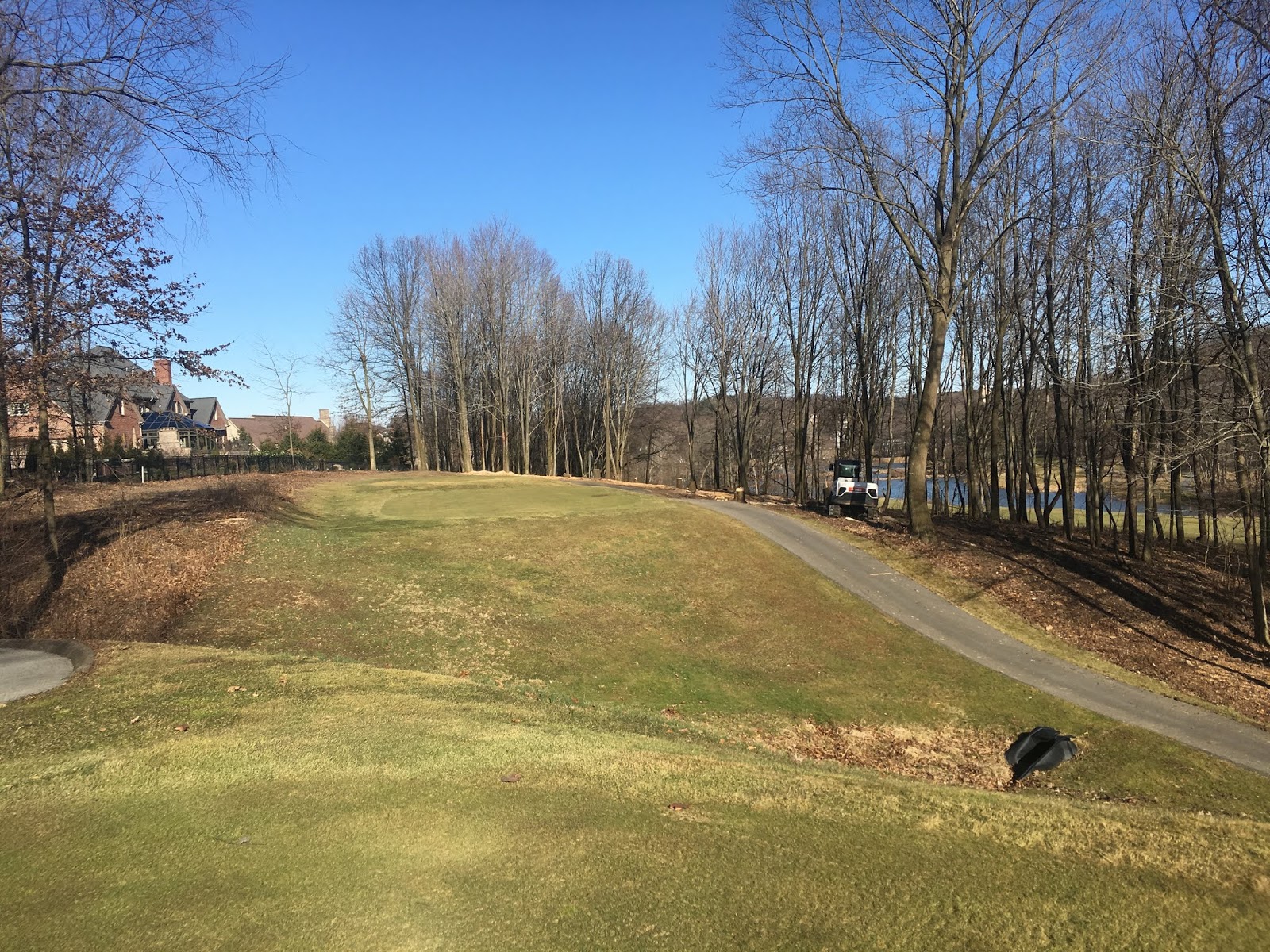
Here's a view of Lakes #9 from the blue tee.  The right side has been opened up considerably, but there are a few more trees that need to come out.
We took a break from the golf course one morning to clean up storm damage and dead trees where the club's property borders the Courtyards at Appleridge.  This was a large Sumac that had split and was leaning towards a neighbor's deck and several utility boxes.
This Cherry tree had lost several large limbs and we could tell it was hollow.  The trunk was filled with ants that were feasting on the rotten heartwood and the tree unexpectedly split while we were cutting.  Luckily no one was injured.

Thursday, February 28, 2019

Course Update 2/28/19

Work continues along the tees on Lakes #8 with 45 trees removed so far.  I anticipate another day or two and we should have this area wrapped up.  It appears the ground may freeze next week from another cold spell, which would allow us to address a few other areas this year.  Despite a few chilly mornings, the dry, sunny weather has been a welcomed break to all the rain!

When leafed out, the large Oak tree to the right of the excavator completely shaded the front corner of the blue tee and was the main culprit for the turf loss.
We're already experiencing a lot more sunlight and air movement on the blue and gold tees with fewer trees.
This view gives you an idea of how much we've cleared along the cart path.

Thursday, February 21, 2019

Course Update 2/21/19

We took advantage of frozen ground earlier this week and continued clearing brush and unwanted trees along the right side of Lakes #9 near the green.  We started clearing the right side of the green last year, but ran out of time and weren't able to finish.  This week we picked up where we left off and worked our way back to approximately 100 yards out from the green.  There was a significant amount of honeysuckle, jaggers, sumac and black cherries that were blocking the entire right half of the green no matter where you were in the fairway.  We pruned up and left a couple large oaks and numerous silver poplars to provide a visual indicator regarding the edge of the hazard.  We should be able to finish the area tomorrow by hauling off some logs and doing one last cleanup of the rough.

The right rough near Lakes #9 green always suffered due to the amount of shade and tree roots taking up all the water and nutrients.
This is the right side of #9 fairway looking back towards the tees.  You get an idea of how dense the vegetation was.  Most of the trees are still there but pruned up.
The right side of #9 green has been cleared except for a large maple to the right of the bunker in this picture.  The tree had a considerable amount of dead wood and major structural damage, which made it an easy decision to remove.
Here's the trunk from that maple tree after we got it on the ground.  We could tell it was hollow by how easily the saw cut through the wood while making a notch.
Here's the stump from that same maple tree.  There isn't much good wood supporting a 30" diameter tree so it was the right call to remove it.
Expanded view of the green from the 150 post in the fairway.

Thursday, February 14, 2019

Course Update 2/14/19

We lost a couple days to rain, but still making progress around the tees on Lakes #8.  28 trees have been removed so far and I'd estimate we're halfway done.  Similar to other areas, we're finding most of the trees are in decline with varying amounts of trunk damage and wood rot.


I'm very fortunate to have a dedicated, hard-working staff that enjoys being outside no matter the weather.
This type of work would not be possible without an excavator with hydraulic thumb.  We rent the machine for 3 months at a cost of $3,000 per month.
The large oak in the center of the picture blocks most of the morning sun on the gold tee and was too close to the tee for pruning to be effective.
Here's what it looks like now with the oak removed.  A few more trees need to come out to allow for full sunlight.
Here's one of the stumps showing a significant amount of wood rot/decay.  This limits the trees ability to circulate nutrients up and down, and causes the trunk to become weak and less able to support the full weight of the tree.

Thursday, February 7, 2019

Course Update 2/7/19

Mother Nature has not made it easy on us the past week with the abnormally warm temps and rain.  The soft, muddy conditions forced us to alter our plans and work in some areas less susceptible to damage from the equipment.  We started the week removing brush and dead trees behind Lakes #2 green, working our way towards #9 then up along the tees.  Following #9 we cleared out the marsh area to the left of #8 approach in front of the green.  Once finished there, we moved to #8 tees and continued removing trees near the water cooler by the silver tee.  We'll be working along the tees on #8 for at least a week given the number of trees that need to come out to allow for sufficient sunlight.  The work area on #8 is less prone to damaging surrounding turf because the cart path is so close to the tree line and there's enough room for the excavator to maneuver in the woods.

While working on Lakes #2 we cleaned up the brush and jaggers along the stream bank adjacent to green
Brush and jaggers removed along the right side of the white and silver tees on #9.  This is looking back towards the blue tee from the silver tee
Lakes #9 from the gold tee.  We can start removing trees down the right side now that the brush is gone and the goal is to see most of the fairway bunkers on the right side.  They are visible now since the trees don't have leaves and it's easy to tell which trees need to come out
We also cleaned up around the bridge on #9 because the brush and vines were taking over the left side
We spent one day in the marsh left of #8 approach removing brush, sumac and willow trees prior to the ground thawing
With the marsh cleared on the left of #8 you can now see the entire green and all the bunkers from the fairway
Tree removal underway near the silver tee on #8.  We'll be working our way along the tees on #8 finishing behind the gold tee

Thursday, January 31, 2019

Course Update 1/31/19

Several more trees have been removed behind and left of the green on Lakes #4 to allow for more sunlight in areas with thin turf.  Two years ago we removed numerous trees along the woodline to improve the turf on the green, which helped tremendously.  Since then, we realized the rough surrounding the green needed help and decided to remove the additional trees.

After finishing on #4 we spent one day around the drainage area left of the cart path on #3.  We started thinning out this area back in December, but didn't have the excavator yet for the larger material.  We still have to flush-cut and grind the stumps, but the area looks great now that the junk is gone.

Tree removal behind #4 green to allow for more sunlight and airflow to improve the rough surrounding the green
View of #4 green from the fairway.  3 trees were removed along the left woodline and 5 trees removed behind the green
Thinning out the drainage area left of the cart path on #3 Lakes
#3 after the brush and debris are gone

Thursday, January 24, 2019

Course Update 1/24/19

Tree work continues on Lakes #4.  A total of 95 trees have been removed down the right side of the hole and at the end of the fairway near the rain shelter.  This is the most amount of trees we've removed on one hole since starting the tree program in 2016, but the improvement in turf quality of both the fairway and rough will be evident this summer.  A few stumps still need to be flush-cut before grinding begins, then the debris and surrounding area will be cleaned up and prepped for seeding in the spring.  While down around the rain shelter, the staff also cleaned up the overgrown banks of the drainage ditch between #4 and #5 to improve the aesthetics and better define the hazard.


View from right of the cart path near the fairway bunkers on Lakes #4.  This area will be seeded in the spring and maintained at regular rough height.
This is the drainage ditch between holes #4 and #5 after the overgrown banks were cleaned up.  It will be much easier to maintain the banks with rough mowers and string trimmers now that the jaggers and small brush are gone.
Flush-cutting stumps is much easier when using the excavator.  We rent the machine for 3 months during the winter at a cost of $3,000 per month.

Thursday, January 17, 2019

Course Update 1/17/19

Tree work continues on Lakes #4 and our productivity has increased now that the ground is frozen.  Several large Maple and Cherry trees have come down along the right of the cart path that will have a noticeable improvement in turf quality.  Another benefit from removing trees is it opens up more width for tee shots at the beginning of the fairway.

View from the blue tee.  Notice how the right side of the hole has opened up by removing the trees that were growing into the line of play.  We also plan to remove a few trees down the left side that are affecting tee shots
Another load of wood being hauled out
This maple tree had a large crack up one side that created an opening for fungus to attack the wood
Here's a view of the infected trunk and you can see the significant amount of wood rot

Thursday, January 10, 2019

Course Update 1/10/19

Tree work continues on Lakes #4 along the right side of the cart path and at the end of the fairway near the rain shelter.  So far 40 trees have been removed and we're already seeing more sunlight in the areas with little to no turf.  We're hoping the sub-freezing temperatures last a while to freeze the muddy ground and make it easier to work in these areas.

The mild weather at the beginning of the week also provided an opportunity to test out the recently acquired fairway topdresser.  It took some time to get the settings dialed in, but we were able to topdress Orchard 2 & lower 8, along with Grove 1 & 9 fairways before the rain.  There was 480 tons of sand piled up in the back parking lot at the clubhouse that is meant for one application to all the fairways.  The topdresser unit can hold 6 tons (12,000 pounds) of sand so it will require 80 trips to topdress all the fairways one time.


Topdressing Orchard 2 fairway

Thursday, January 3, 2019

Course Update 1/3/19

Tree removal is in high gear now that the holidays are behind us and we're working on Lakes 4 along the right side of the cart path.  Several trees were removed along the left side of the path last winter to allow for more sunlight and airflow around the fairway bunkers, but we quickly determined that more trees needed to come down to achieve our goal of having good quality turf down the right side of the hole.  Removing the trees will also keep the fairway and surrounding rough drier.


Chipping the first of many trees

Trees are removed first then the stumps are flush-cut and ground down

The maintenance staff hard at work

All the trees right of the cart path have damaged trunks that will eventually lead to death of the tree

A majority of the trees removed so far are showing signs of wood rot that most likely started because of a damaged trunk and/or compromised roots

Surface roots cause problems for golfers and mowing equipment, and are typically associated with poor soil conditions