Thursday, June 7, 2018

Course Update 6/7/18

Sod Work
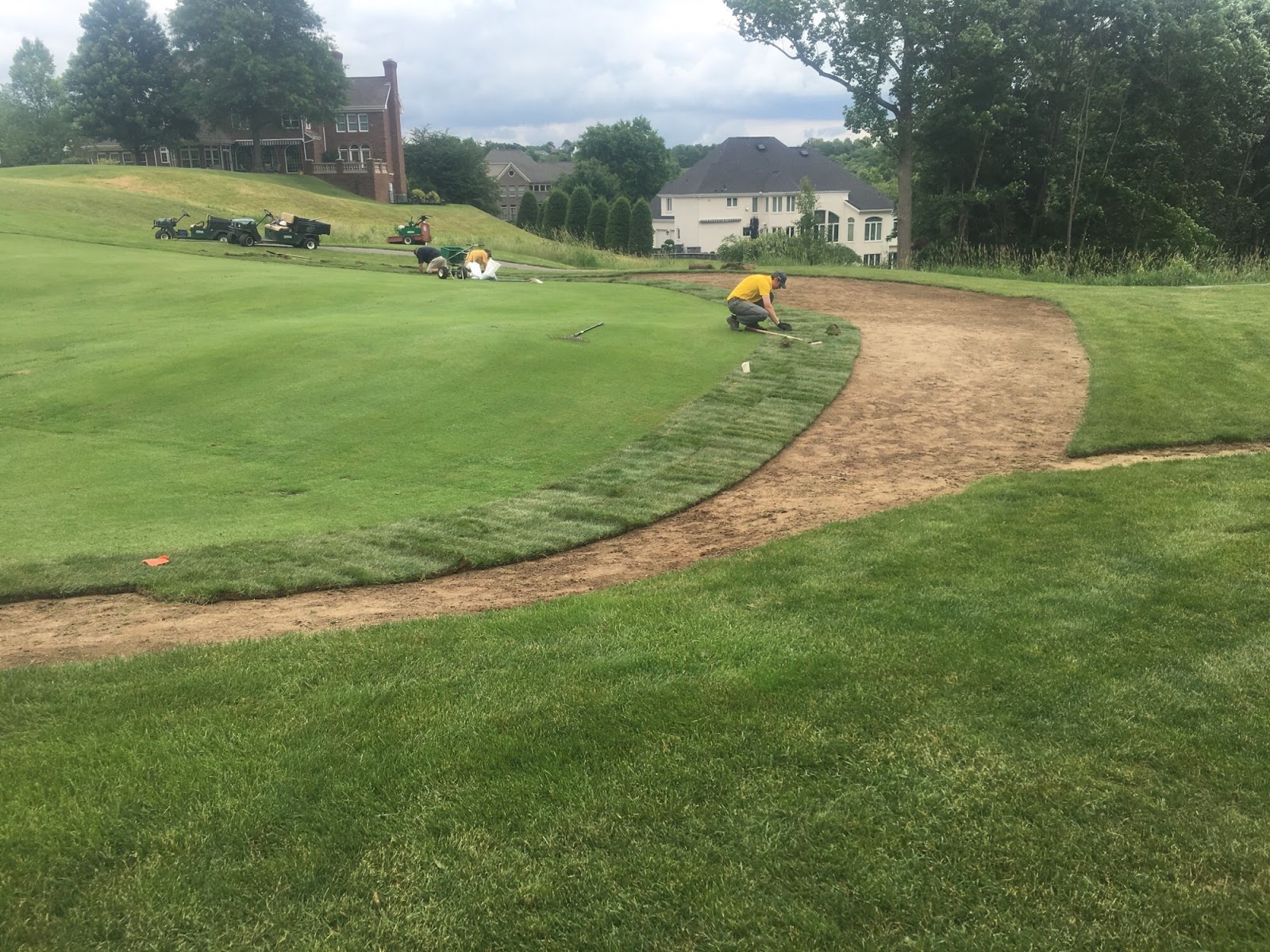
This week we addressed some areas in the rough by installing turf-type tall fescue sod from a nursery near State College.  Turf-type tall fescue has been gaining popularity over the past decade due to it's desirable characteristics and more nurseries are growing it.  As the name implies, it has finer texture leaf blades similar to ryegrass and bluegrass.  Kentucky bluegrass has long been the "standard" when it comes to rough sod, but turf-type tall fescue has a darker green color, is less prone to disease and insects, can hold up better when subjected to increased foot and cart traffic, and does not require as much water during the summer as Kentucky bluegrass.  We brought in seven pallets (4,200 sq.ft.) on Monday to finish up some areas on Orchard 5 & 6, along with between the gold and blue tees on Grove 3.  We still have some leftover and started sodding stump holes around Grove 2 green.


Rough area on Orchard 5 prepped for sod

Orchard 5 after

Rough area before Orchard 6 fairway prepped and starting to install sod

Orchard 6 after

Thursday, May 31, 2018

Course Update 5/31/18

Greens:  The turf has been a little off-color, but that's in response to the stretch of hot weather we recently experienced and is not an indication of poor health.  We wanted the root zone to dry out and force deeper rooting, which will help the turf survive the stressful summer season.  We had some dry spots show up in the collars which we addressed by hand watering, but overall the turf held up great during the first heat wave of the season.  We also lowered the mowing height again this week and the greens are rolling great.

Tees:  The tees are also a little off-color and are due for an application of fertilizer.  We'll use an organic 5-4-5 fertilizer next week which will green them up and help with divot recovery.  Organic fertilizers are safe to use in warm weather and release their nutrients over 8-10 weeks.

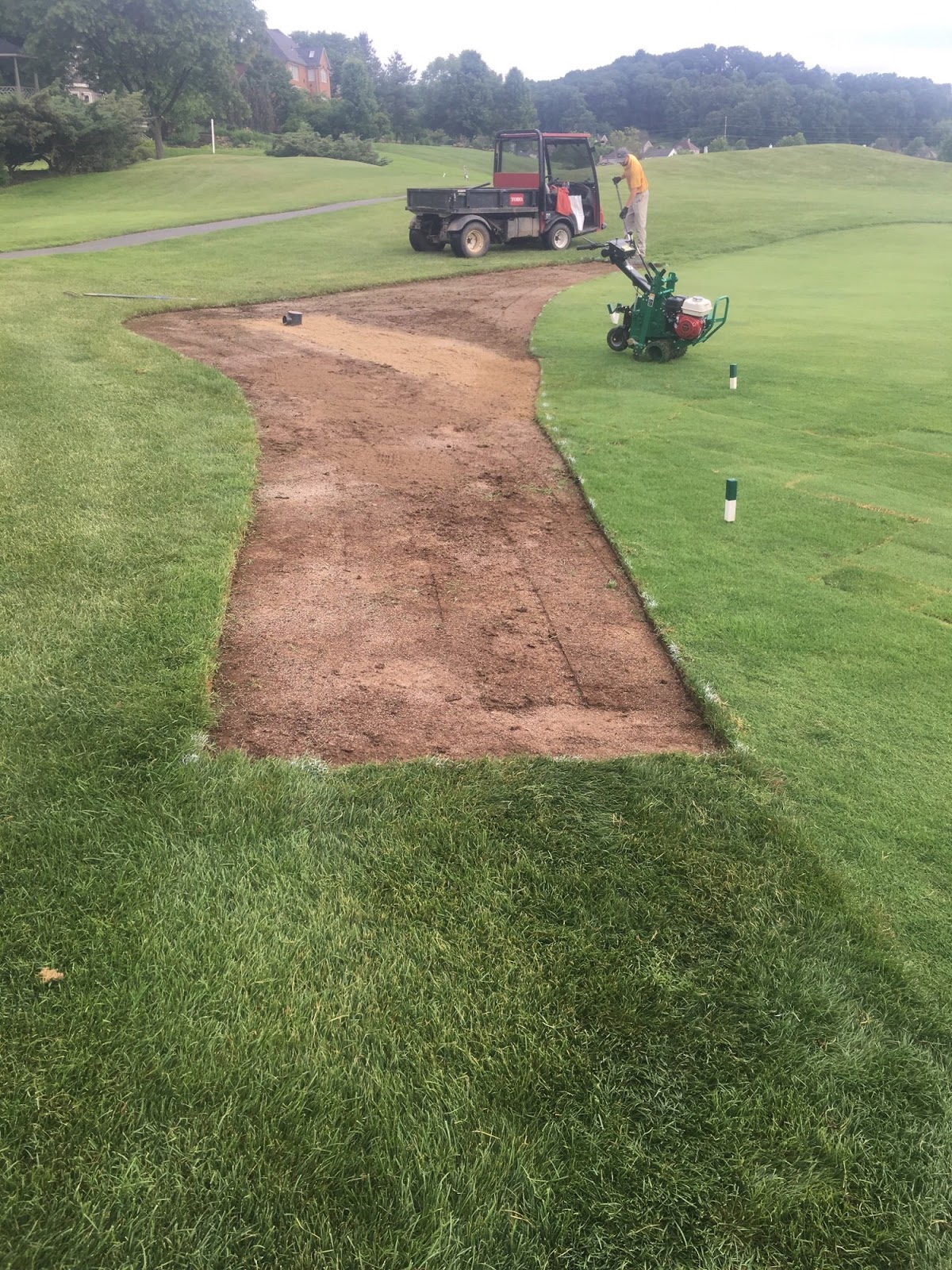
Fairways:  The turf is healthy and has great color.  Many of the bad fairways from last year have improved dramatically and will continue to get better.  Even though it was hot and dry earlier this week, we were finally able to sod the two drain lines on Orchard 5 and the areas in Lakes 5 approach.  The sod will need to be rolled and topdressed several times before it's ready for play, so please keep off of it as much as possible.  The beginning of Orchard 6 fairway is scheduled to be sodded early next week, depending on the weather.

Bunkers:  Edges were trimmed this week and that process will occur every few weeks depending on how quickly the turf grows.  The grass surrounds were sprayed with a herbicide several weeks ago to control weeds, but will need to be sprayed again as new weeds have emerged.

Recently sodded drain line near the green on Orchard 5 fairway

Recently sodded drain line in the middle of Orchard 5 fairway

Low areas void of turf prepped for sod on Lakes 5 approach

Recently sodded areas on Lakes 5 approach

Thursday, May 24, 2018

Course Update 5/24/18

Greens:  Poa seedheads are almost gone and we've been slowly lowering the mowing heights for the past week.  Expect faster green speeds over the next few days as things dry out.  Weekly growth regulator and fertility sprays are being applied in small amounts to keep the turf in peak condition going into summer.  Expect to see light applications of topdressing sand every few weeks to help dry out and smooth the putting surfaces.

Tees:  The new tees on Grove 2 & 3 are ready for play and will open tomorrow.  The temporary tees that were being used will be aerified, seeded and topdressed to promote faster recovery.  I anticipate several weeks for them to fully recover.

Fairways:  The turf has greatly improved since last year, but we still have numerous areas that require attention.  We had planned to start sodding areas this week, but the wet weather changed those plans.  We'll try again next week.

Rough:  If you sat there long enough, you could probably see the rough grow.  Even with every available body assigned to maintaining the rough in the afternoons, we still can't keep up with it.  It appears the seedheads are starting to thin out, and that's a great indication that the rough will be transitioning into it's summer growth stage and hopefully start slowing down.  In addition to mowing, we've started string trimming all the various items throughout the property.  This time of year we send out a trimming crew every week or two.  As the summer goes on and we experience drier conditions, not as much trimming is required.  Still have some dandelion, clover and thistle emerging, and we plan to resume herbicide applications next week.

Stump Grinding:  The contractor needed to take care of some other small jobs and will be back on site once those are complete.


Have a wonderful holiday weekend!

Thursday, May 17, 2018

Rough Mowing

As in past years, the question I get asked the most around this time is "When are you going to cut the rough?"  In case you're wondering, we maintain 110 acres of primary rough and 70 acres of outer rough (tall grass areas).  The primary rough is what surrounds greens, tees, and fairways, and is mowed at 2.25 inches.  As mentioned in last week's post, 5 mowers are out every day cutting primary rough, and with good weather and normal growth it requires 4 full days to get thru the property one time.  I mentioned good weather, which consists of sunny, dry days and lower humidity so the turf isn't so lush.  Normal growth refers to one inch of new leaf tissue over a week's time.  For the most part, this year has seen the exact opposite.  Rain every day or two, limited sunshine, and high humidity, which has resulted in lush, dense turf that will grow 2 inches or more in one week.  Mowing this tall, dense turf requires more power for the blades so the mower can't travel as fast to achieve a uniform cut.  Going slower requires close to 6 days to mow all the primary rough one time, so don't be surprised if you see mowers out on the weekends.  Normally, this springtime growth flush will subside by Memorial Day, but I'm not sure what to expect this year.

We have 2 of these articulating trim mowers that are ideal for hilly terrain around greens, tees, and bunkers.  They cut 82 inches wide and cost $30,000 each.

We have 3 of these big units that maintain the large, open areas.  They cut 108 inches wide and cost $80,000 each.

Thursday, May 10, 2018

Course Update 5/10/18

Greens:  Aerification holes have healed and we will start lowering the height of cut next week.  Poa annua seedheads have emerged so verticutting will also begin next week, followed by a light topdressing.  The seedheads are what cause the greens to be bumpy and slow this time of year.  Several verticutting and topdressing applications in the spring helps remove the seedheads and makes for a faster, smoother putting surface.

Tees:  Grove tees were core aerified on Monday 5/7.  Lakes tees are scheduled to be aerified on Monday 5/14, with Orchard tees immediately following.  The new tees on Lakes 6, Orchard 9, and Grove 9 are open for play and receiving fantastic reviews.  The new tees on Grove 2 & 3 require a little more time to mature and stabilize, since they were completed so late last season.  Once all the tee sod is fully established we will apply topdressing sand and aerify with 3/8" diameter solid tines to work the sand into the turf canopy and fill any remaining sod seams.

Fairways:  Core aerification was completed last Wednesday and the fairways look great.  This is the first time in many years that spring aerification was performed, but it is a necessary practice that will be done twice per year going forward.  Now that aerification is complete, we can finish the drainage projects on Orchard 5 & 6, along with addressing some other areas of poor turf quality.  Soil moisture levels have dropped to allow cart traffic, but please observe the 90 degree rule and keep carts on the path near greens and tees.

Rough:  Each day, 5 mowers and 3 blowers are trying to keep up with the usual springtime flush of growth.  We haven't fertilized yet, and the rough should start to thin out in another couple of weeks.  Broadleaf weeds such as dandelion, clover, and thistle have emerged and we started spraying herbicides this week to control them.

Bunkers:  Regular maintenance has begun which includes raking, edging, checking sand depths, and adding sand when necessary.

Stump Grinding:  A contractor has been on-site grinding stumps to the left of Grove 6 before the pond.  He then spread the piles of debris that have accumulated over the years in preparation for seeding.  He will be grinding stumps in close proximity to greens/tees/fairways first, then address the stumps along the outer edges of the property.  The ground material will be cleaned up and removed, and topsoil will fill the cavity.  Seed or sod will be used depending on location and weather conditions at the time of repair.
Thursday, May 3, 2018

Fairway Aerification Update

We finally got some warm, dry weather and it just happened to coincide with fairway aerification.  To maximize efficiency and minimize the disruption to the membership, a contractor was used to core aerify all 40 acres of fairway over three days this week at a cost of $11,000.  For the maintenance staff to perform the same task in-house would require $150,000 in additional equipment and we would not have the staff available to properly maintain the 18 holes that were open for play.  Maintenance costs, storage space, and insuring the specialized aerification equipment must also be considered and that's why we choose to contract the service.

The first step in the process is to flag (mark) all of the drainage basins, irrigation heads, yardage markers, and anything else we don't want the aerifiers to hit.  The aerifiers can then start extracting a 3/4" diameter core approximately 4" deep on a 3"x 3" square spacing.  This spacing equates to 19 holes per square foot, 827,640 holes per acre, and 33,105,600 holes across all 40 acres. The cores are then left on the surface to dry for an hour or so before they can be dragged and broken up.  If the cores are too wet they will stick together and form little mud balls that clog the drag mats and take even longer to dry.  If we wait too long and the cores are too dry they will become very hard and not break up when dragged.  Once the drag mats have gone over the fairway several times and the cores are broken up, another piece of equipment is used to further pulverize the soil and any remaining cores.  The goal is to break up the soil so it fills some of the aerification holes and work it back into the turf canopy.  This helps to control thatch buildup and reduces the amount of material that needs to be collected and hauled off.  Since the soil is heavier it will settle into the turf while the light-weight thatch will remain on the surface.  As soon as the pulverizer is done, a team of three high-powered blowers start clearing the fairway surface.  The thatch is blown into the rough where it is collected by a large sweeper.  The sweeper will make several passes around the fairways to collect all the debris, then run over specific areas in the fairway where the soil/thatch has accumulated.  The forecast calls for some rain over the next several days along with temperatures in the 70's.  These conditions are ideal for turf growth and I anticipate 7-10 days for the fairways to recover.

Click the links below to learn more about aerification and why it's necessary.
https://www.golfdigest.com/story/why-your-course-aerates-and-why-you-should-be-happy-about-it
https://www.usga.org/course-care/forethegolfer/why-do-golf-courses-aerate-so-much-.html


Aerifying 40 acres requires big equipment

One of two 300 pound steel drag mats breaking up the cores

The pulverizer in action

The end result after all steps

Thursday, April 26, 2018

Course Update 4/26/18

It was another week of wet weather, but at least it didn't snow!  We're up to 4.47" of liquid precipitation this month and still have 4 days to go.  Our average for April is only 3.11".  Anyone who has played recently knows how wet the courses are, and it's been challenging trying to keep everything mowed now that most of the turf has resumed normal growth.  The two biggest issues we're dealing with right now are ruts and shallow roots.  The ruts will be fixed once the courses dry out through rolling/tamping, then leveling with soil and sowing seed.  They should recover quickly with good weather, but we'll have to look at them for a little while longer.  The shallow roots are a bigger concern for turf health this summer.  In a normal spring with average precipitation, plant roots are actively growing longer in search of water and nutrients.  Longer roots allows the turf to prepare for the stressful summer season where root loss is common.  With everything being so wet this year, the roots do not have to search for water and nutrients deeper in the soil.  They will remain fairly shallow until conditions dry out forcing the roots to grow deeper.  The recent aerification of greens helps with root production by relieving compaction and making it easier for water and nutrients to move deeper in the rootzone.  Aerification also increases oxygen levels in the soil for healthy root growth.  New this year, we will be core aerifying tees and fairways both spring and fall to start addressing the issues that arose last season.  The same benefits will be achieved as mentioned for the greens, and expect to see the process started in the next week or two depending on what the weather does.

Speaking of greens aerification, the pictures below were taken on Grove 7 green.  It's only been a week since DryJect occurred, but the holes are almost completely healed.  Orchard greens were completed today and should be completely healed in 7-10 days.

DryJected green on 4/18

Same green on 4/25

Thursday, April 19, 2018

Course Update 4/19/18

Well, it's been another week of wild weather.  Last Friday and Saturday it was in the 80's, and today had snow showers (with a little accumulation).  At least yesterday was nice for DryJecting greens.  Grove, Lakes and both practice greens were completed, then the surface was dragged to work any remaining sand into the turf canopy.  We were planning to roll those greens today, but the snow and wet conditions prevented us from doing so.  Tomorrow is supposed to be warmer and drier, so we'll try again.  Orchard greens are scheduled for DryJect on Wednesday, 4/25.

Click here to see how the DryJect process works. 

So far this spring we haven't been able to perform any kind of routine mowing, but as mentioned in an earlier post, we stay busy with other tasks.  This week, those tasks included:

  • Pulling weeds, edging and general cleanup of the landscape beds around the clubhouse
  • Removing brush that was laying in the water along the edge of the pond on lower Orchard 8 fairway
  • Removing piles of aerification plugs dumped along the perimeter of some holes
  • Pressurizing and testing the irrigation systems, along with making repairs when necessary
  • Helping Doug uncover the pool so he can get it ready for the summer
  • Trimming around and clearing blocked drainage lines to handle the excess rainfall
  • Cleaning up sticks and debris from recent storms
  • Repairing washouts in bunkers

Piles of brush removed from the pond near the lower fairway on Orchard 8

Kevin, David and Justin keeping the DryJect machine filled with sand on Grove 9 green

Putting surface after DryJect. The little bit of sand remaining will be spread across the green and worked into the canopy by the drag brush

Thursday, April 12, 2018

Colorful Putting Greens

Anyone who has played recently has probably noticed the color variation in the greens.  All of the putting greens are a mixture of Bentgrass (Agrostis palustris) and Annual Bluegrass (Poa annua).  They typically have a blotchy or patch-like appearance this time of year, but the color variation is not an indication of poor turf health.  Bentgrass is the slowest to come out of dormancy, and tends to take on a darker appearance in the spring and fall.  Poa on the other hand is first to break dormancy, and is further differentiated based on whether it's a perennial or true annual biotype.  Similar to Bentgrass, the perennial biotypes tend to have a darker appearance, while the annual biotypes appear more lime green.  Some of what you're also seeing is old leaf tissue from last season, which makes the putting surface appear white or tan.  That tissue will be removed with each successive mowing as the plants resume their active growth and produce new tissue.  With a few more warm days, the turf will "wake up" and the color variations should be less noticeable.


Bent/Poa green with color variations normally found this time of year

Thursday, April 5, 2018

Course Update 4/5/18

It was another week of lousy weather, but we made the best of it.  Greens were mowed for the first time on Saturday and have been water logged or frozen ever since.  Tees and fairways need to be mowed, but are too wet to even think about putting a mower on.  The 10-day forecast doesn't look much better, in fact it's supposed to be another very cold weekend.

Even though we haven't been able to conduct our usual turf maintenance tasks this year, there is plenty to do.  We finished up the tree work on Grove 2 & 3, rejuvenated the landscape bed surrounding the well head on the right of Orchard 5, tried to work in the bunkers but the sand was frozen, cleaned up debris around the Clubhouse several times thanks to the 50mph winds, continued course cleanup where there wasn't standing water, finished powerwashing the equipment, sanded and painted tee markers, and started filling the irrigation system.  There are several other tasks not listed here, but you get the idea.

Woke up to 3" of snow Monday morning

1.25" of rainfall on Tuesday.  Didn't think it was possible for the course to get any wetter

David Novak making sure all the equipment is looking it's best

Landscape bed on Orchard 5 needed a rejuvenation this year

All 232 tee markers are painted every year by our long-time mechanic, Randy Miller

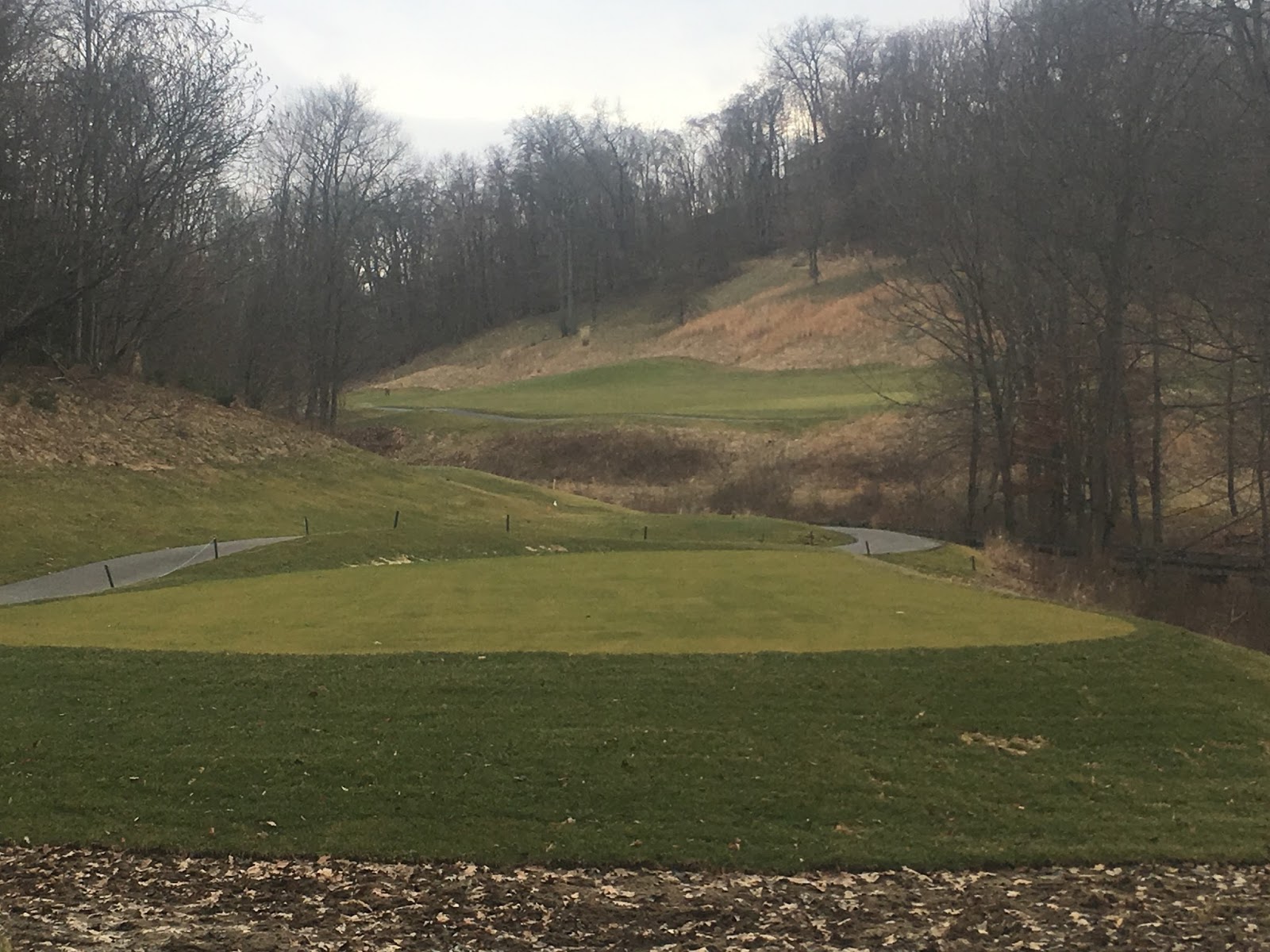
Grove 3 tee...before

Grove 3 tee...after

Multi-stem maple tree near Grove 3 cart path removed for safety reasons.  The dark areas are decaying wood and the light color is healthy wood